
The Hidden Retail Inventory Problems Fitness Clubs Face as They Grow
Last Updated: December 31, 2025 by Braiden Blank
In-club retail is no longer “nice to have” for multi-location fitness operators. Now, it has become an essential non-dues revenue stream. The recent reality is that most substantial multi-location clubs already sell retail. The opportunity for a member to grab an energy drink before a workout or pick up a supplement after an exercise class is no longer an add-on; it’s expected.
Simultaneously, the fitness industry is growing at an unprecedented rate. According to the 2025 Health & Fitness Association (HFA) Benchmarking Report, the global median revenue growth rate was 9.9% in 2024, with larger, multi-location operators growing even faster at 11%.
Larger operators are projecting tens, even hundreds, of new club openings in a single year. Planet Fitness was projected to open nearly 200 clubs in 2025, while Xponential Fitness (parent company of BFT, Club Pilates, Purebarre, etc.) is expected to open over 300.
What does the standardization of in-club retail and the significant growth of the fitness industry mean for fitness clubs? It means they have to scale their retail operations across multiple locations as they open new clubs at a rapid rate. A new challenge is presented: creating a process that enables scalable inventory management for fitness clubs and wellness centers.
As many operators are forced to amplify their retail operations across more locations, they realize that they’ve outgrown the way they started–and that’s a good problem to have.
In this post, we’ll break down why early inventory workflows become ineffective as fitness and wellness clubs grow, the operational gaps that appear, and how scalable inventory processes and technology help restore control and visibility.
Why Early Inventory Workflows Aren’t Scalable
In the early stages with a small number of clubs, inventory management is usually informal and manual.
Common workflows include:
- Ordering via email, spreadsheets, clipboards, or shared documents
- One person or a small team handling all retail ordering
- Limited structure around ordering approvals and visibility
- Lack of role separation between the club, region, and corporate levels
This approach works in the beginning. With few locations and low order volume, manual processes feel efficient. After all, decisions are quick, and communication is simple. Everyone “knows what’s going on.”
However, growth changes the equation. What often works at a few locations becomes a bottleneck as that number multiplies.
Problem #1: Ordering Becomes a Bottleneck
The bottleneck theory states that throughput is limited by the slowest step in a process. In other words, A system is only as strong as its weakest link.
When a fitness brand adds locations, ordering volume grows rapidly. Meanwhile, the ordering process itself stays the same in many organizations, leading to a predictable outcome: what was once efficient gradually becomes a bottleneck.
As organizations grow, common problems include:
- No consistent way to submit orders
- No hierarchy or standardized process for approving orders
- Reviews that are dependent on inboxes, memory, and situational follow-ups
In some cases, ordering continues to occur at the corporate level instead of the club level, even at fitness organizations with dozens of locations. When one person or a small team of people at the corporate level orders inventory for every club, the process becomes reactive instead of proactive. Decisions are made after stockouts occur, rather than utilizing data to track and predict demand.
Some organizations may be resistant to changing their ordering system because right now, what they have “works.” And in many cases, this statement is true because the system still functions. However, it doesn’t function intelligently and efficiently at scale.
Workflows that rely heavily on individual effort, memory, and inconsistent processes tend to hold up until growth exposes their limits. As businesses scale, systems like these reach limitations, such as:
- Situations that consistently require manual intervention
- Greater chance of missed orders and errors
- Inability to respond to demand at the location level
The level ordering occurs at (club, region, or corporate) matters because demand is not always consistent across locations, especially in different regions. Multi-location retail studies consistently show 20-40% variance in product velocity between locations, even within the same brand.
As the fitness industry grows and fitness and wellness clubs grow along with it, the goal should not be to keep operations “functional.” Instead, it should be to create a standardized system that is driven by data and scales with the growing business. Inventory systems should be a tool that supports and drives growth, not holds your processes back.
Problem #2: Loss of Visibility at the Location Level
As fitness operators add locations, inventory visibility often decreases before they realize it. Data is more difficult to break down by location and region, and becomes fragmented across disconnected systems. While retail leaders may have access to high-level numbers, the importance of location-specific data is undervalued.
When data is only present in spreadsheets, emails, and documents, it’s hard to see what’s actually happening at each club in order to make meaningful connections between them. Without structured visibility at the club, region, and corporate level, trends are harder to recognize, underperforming or overperforming locations are difficult to identify, and decisions lack proactivity.
This lack of visibility gradually hinders decision-making and prevents early-action retail management. Leaders are forced to respond to problems after they surface, rather than utilizing data that can be broken down to the location level to anticipate demand and prevent issues from the start.
Problem #3: Accountability Fades As Scale Increases
With continued growth and the addition of locations, inventory processes become more complex, and accountability becomes unclear. This is where the importance of inventory responsibilities comes into play. Without clearly defined roles at every level of the organization, retail outcomes lack ownership. Teams at individual locations may feel disconnected from decisions when they don’t have a clear role, and corporate teams lack the context to trace outcomes down to the result.
Without the ability to trace a problem back to its cause, losses accumulate and continue to go unnoticed. Even small variances multiply across locations. In retail, shrinkage typically accounts for 1-2% of revenue, but in multi-location environments with limited visibility, that number often climbs quietly as scale increases.
When no single role is responsible for ordering, receiving, and reconciling inventory at the location level, shrinkage becomes easier to dismiss as “normal” rather than something actionable.
Growth doesn’t create shrinkage; it hides it. Without the proper roles in place for scalable inventory management of fitness clubs, growth amplifies inefficiencies instead of allowing sustainable operations.
Why Inventory Structure Must Evolve as You Grow
Business growth requires more than added effort. Process evolution is vital to keep an organization running smoothly as operations become more complex. Static workflows function in the beginning with a few locations, but they don’t scale. Systems that allow room for growth must support:
- Actions like ordering, receiving, and reconciling at the location level
- Central oversight and process review
- Clear accountability at every level
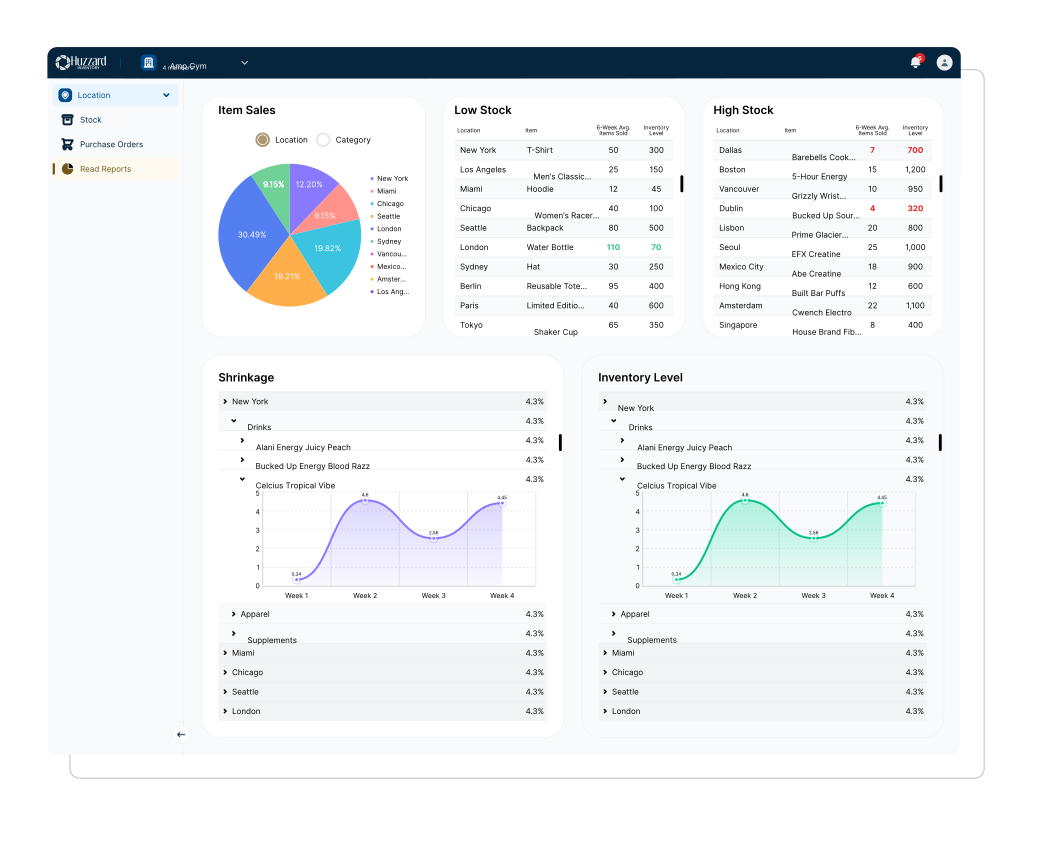
- Real-time visibility overall, as well as at the region and location level
The goal of inventory supervision at the corporate level should not be to control operations at every stage. Individual locations should be held accountable for their own ordering, receiving, and reconciling by using a process with built-in oversight and review of individual workflows at each location. Ultimately, the goal is to bring structure and clarity to the process.
Implementing Scalable Workflows and Hierarchies
Scalable inventory management for fitness clubs is supported by processes that facilitate growth within the business. An example of a modern workflow looks like this:
- Distributor systems are integrated with inventory software, so clubs know what items are in or out of stock on the distributor’s end
- Individual clubs predict demand with their own real-time purchasing data
- Clubs submit orders based on demand predictions and stock counts
- Orders route to someone who oversees retail operations (Director of Retail, Retail Manager, etc.)
- Retail leader makes the approval
- Once approvals happen, orders are automatically sent to distributors through the integrated system
- Shipments are received at each club, and inventory is updated
When clubs switch to this workflow, leadership maintains management without becoming a bottleneck. Visibility and accountability exist at every stage.
It is also possible to get more granular by looking at the individual roles at each level.
Club level:
- Submit orders
- Receive and reconcile inventory
- Oversee data from only their own location
Regional level:
- Oversee performance across assigned locations
- Analyze regional demand trends
Corporate level:
- Set product categories within inventory management software
- Establish ordering limits or restrictions to avoid errors (e.g. case quantity caps, seasonal availability controls, end-of-life products, etc.)
- Define roles and permissions
- Approve orders
- Maintain visibility across all locations and regions
When inventory workflows are structured for growth with the continued adoption of locations, ordering and approvals happen faster, ownership is clearly defined, and errors surface sooner. Shrinkage can also be found, traced, and addressed before it compounds. This structure allows decisions to be made close to demand, with clear oversight in place.
Why Some Clubs Hesitate to Change
Operational changes can feel risky, especially during rapid growth. With increasing demand in the fitness industry, many clubs are so focused on expanding their brand that they postpone optimizing their outdated systems. They may worry that changing processes could disrupt operations or limit control.
In reality, the bigger risk is waiting too long. The most successful fitness organizations don’t wait for operations to become unmanageable. They recognize the problem and decide to take action by evolving systems early, before growth exposes the cracks.
Scale Requires Systems That Grow With You
Scalable infrastructure is the key to retail success in a growing fitness business. The brands that scale effectively invest in inventory systems that are designed to support expansion before their existing system hits operational constraints.
As fitness clubs expand, inventory processes must evolve, or they become the bottleneck.
Learn more about scalable retail inventory management that supports multi-location fitness clubs and wellness centers.