
The Untapped Goldmine Inside Your Fitness and Wellness Business: Retail Revenue
Last Updated: October 29, 2025 by Braiden Blank

Membership dues drive the majority of fitness club and wellness center income, but one of the most overlooked income sources is right under your nose: retail revenue.
According to the Health & Fitness Association’s (HFA) 2025 Fitness Industry Benchmarking Report, nearly 30% of U.S. club revenue now comes from non-dues sources: everything beyond monthly and annual membership fees. This shows that retail revenue in fitness clubs is becoming an increasingly important contributor to total income. For many clubs, that includes retail sales of apparel, supplements, drinks, and accessories.
In this post, we will look into how simple and scalable the implementation of retail revenue can be, and how some of the most successful fitness and wellness operators already leverage it.
The Growth of Non-Dues Revenue in Fitness Clubs and Wellness Centers
Membership dues continue to be the top revenue source for fitness and wellness businesses. However, non-dues revenue is increasingly becoming an important way to stay profitable and competitive for the most forward-thinking clubs.
According to the 2025 HFA Benchmarking Report, non-dues operations now make up 29.5% of total U.S. fitness club revenue. And the gap between small and large operators tells an important story:
- Clubs with over $5 million in annual sales generate 36.4% of revenue from non-dues activities.
- Clubs with less than $1.5 million in annual sales generate only 21.2% of revenue from non-dues activities.
When translated into dollars per member, that means large operators earn roughly $905 per member per year in non-dues revenue, compared to just $287 for small operators.
In other words, the most profitable operators aren’t relying solely on membership–they’re diversifying through retail, services, and ancillary offerings. As the report notes,“Ancillary offerings remain a key differentiator, especially for smaller operators in competitive markets.”
Retail: The Simplest Revenue Stream to Implement
Some forms of non-dues revenue, like personal training, group fitness, or cryotherapy, can generate high margins. However, these revenue streams often require additional staff, certifications, and space. Retail, by contrast, is one of the easiest and fastest ways to add incremental income with minimal overhead.

Launching a retail area, pro shop, or wellness counter doesn’t necessarily mean large renovations or new hires. A basic setup of coolers and shelves can quickly convert unused reception space into extra revenue that also reinforces your brand.
The data confirms it: only 29.4% of smaller U.S. firms have a pro shop, compared to 76.2% of larger firms. The clubs generating higher overall revenue are those already leveraging retail as a consistent profit center.
Retail also strengthens your marketing. Selling branded apparel, supplements, or small accessories gives members a sense of belonging. More importantly, it helps your logo walk out the door with them.
Why Retail Revenue in Fitness Clubs is Overlooked
For a new club owner, or an established one that hasn’t tapped into non-dues revenue, the idea of managing retail can feel overwhelming. You know fitness operations, not inventory logistics.
Yet retail is often simpler than it seems. Unlike personal training or wellness programs, it doesn’t require new staff or added space. However, it does require efficient inventory management.
Common challenges include:
- Shrinkage: lost or untracked products.
- Reconciliation headaches: manual stock counts that take hours.
- Lack of visibility: no real-time data on what’s selling or sitting.
These issues don’t exist because clubs don’t care; they exist because most retail tracking systems weren’t built for the unique environment of fitness clubs and wellness centers. Tracking hundreds of small SKUs, from energy drinks to branded apparel, across multiple locations requires a retail solution that understands how clubs operate.
That’s exactly why many operators are turning to automated inventory software built specifically for growing retail revenue in fitness clubs and wellness centers.
At Huzzard, we designed our Retail Inventory Software for fitness and wellness clubs that sell apparel, supplements, and cooler products. It syncs directly with your club’s POS and management system, so every sale instantly updates stock levels. One operator cut reconciliation time by 75% after switching to automated inventory software.
If your club struggles with the same issues, you can learn more about how Huzzard Retail Inventory helps simplify retail management for fitness and wellness businesses.
The In-Club Advantage Over Online
It’s no secret that online shopping has changed consumer habits. But as Kevin McHugh, COO of The Atlantic Club, noted in HFA’s article “Rethinking Retail: Your Gym’s Untapped Non-Dues Revenue Source,” he reminds us:
“Online shopping has affected everyone. Still, in the case of in-club retail, we know our customers and can give them individual attention. That’s something they’ll never get online.”
Your members already know and trust your brand. Selling retail products within that relationship offers convenience and relevance that e-commerce can’t replicate. The experience feels local, authentic, and community-driven.
Getting Started with Retail Revenue
You don’t need a massive shop to start generating meaningful income. You can start small, keep track of your data, then scale from there.
Here are some pointers to get started:
- Begin simple: Apparel, supplements, and a few coolers of drink products.
- Track best-sellers by season: Keep data on what moves fastest.
- Partner with distributors: Find profitable items utilizing companies like N2G.
- Utilize real-time inventory data: Restock smarter by investing in tools that give you visibility into inventory turnover.
Even a minimal retail setup can easily turn into a profitable, popular amenity for your members.
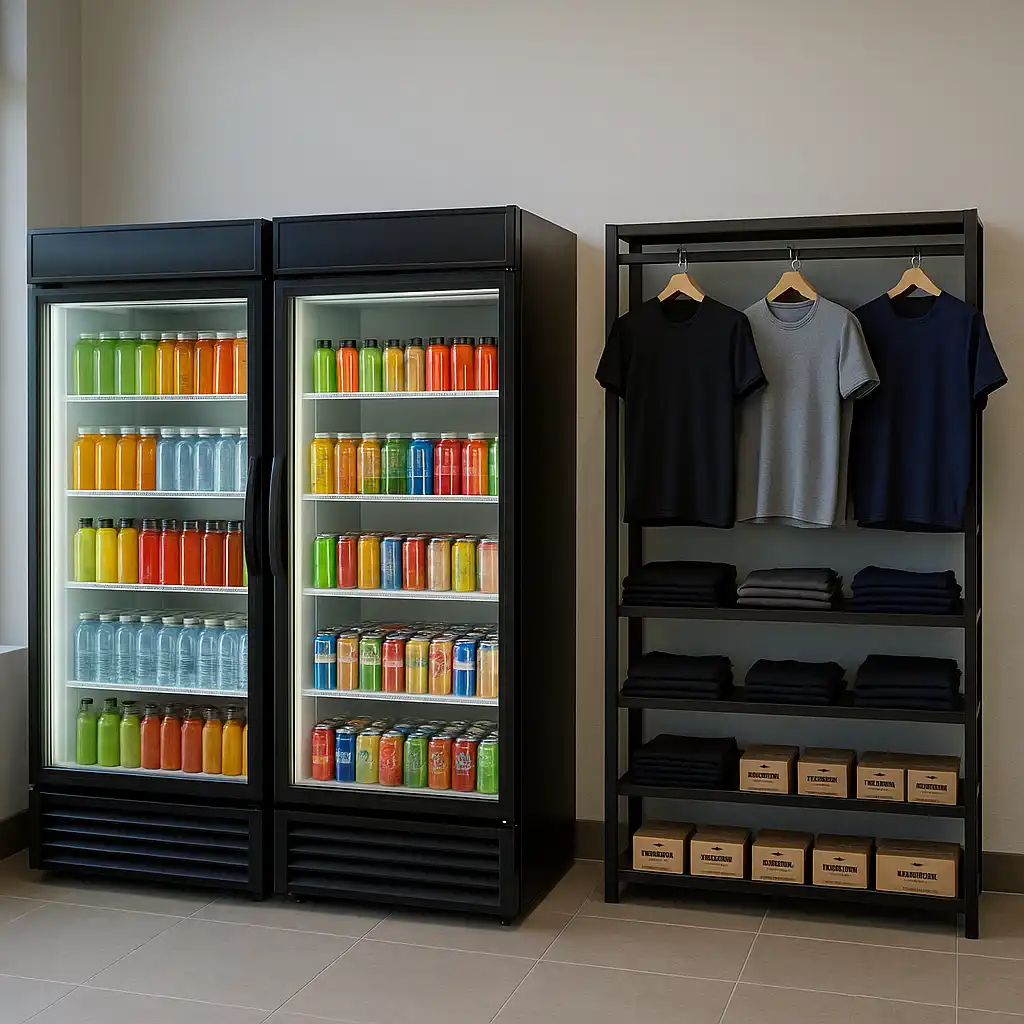
Industry experts agree that smart selection of retail products and strong margins are the key to success. Bill McBride, president and CEO of Active Wellness, explains:
“Some clubs have been very successful with nutraceuticals–supplements, meal replacements, and smoothies. Strong apparel brands also are getting good traction.”
He also suggests a practical pricing approach:
“Think ‘airport pricing.’ Choose a product line with a high margin, such as water, and mark up for the convenience you’re providing.”
Meanwhile, Jillian Leo, former director of retail operations for Crunch Fitness and Blink Fitness, highlights how innovation continues to drive growth:
“To some extent, despite all of the new options, we’re still talking about a pro shop. But the industry is exploding with new products–from natural drinks and bars to vibrating foam rollers. Clubs with retail space have the chance to be among the first to sell some of these new and unique items.”
Another approach that is proven to increase sales is directly tying products to classes and events through your business. This looks like selling branded mats after a yoga class, recovery drinks after HIIT, or foam rollers after a mobility workshop. As Leo also notes, linking a product to a member experience can significantly boost sales and engagement.
When curated and connected to your club’s lifestyle offerings, retail becomes more than a side revenue stream–it becomes a natural extension of the member experience.
Turning Untapped Potential Into Profit
Retail revenue in fitness clubs remains one of the industry’s most underutilized yet proven revenue streams. It doesn’t underperform because members don’t want to buy; it underperforms because clubs often lack visibility into their own sales data.
Managed effectively, retail strengthens your brand, your community, and your member experience.
And when you’re ready to eliminate the manual headaches that hold retail back, automated retail inventory management software can help you unlock the full potential of this untapped goldmine.
Discover how Huzzard Retail Inventory Software helps fitness and wellness businesses simplify retail management.